Overview
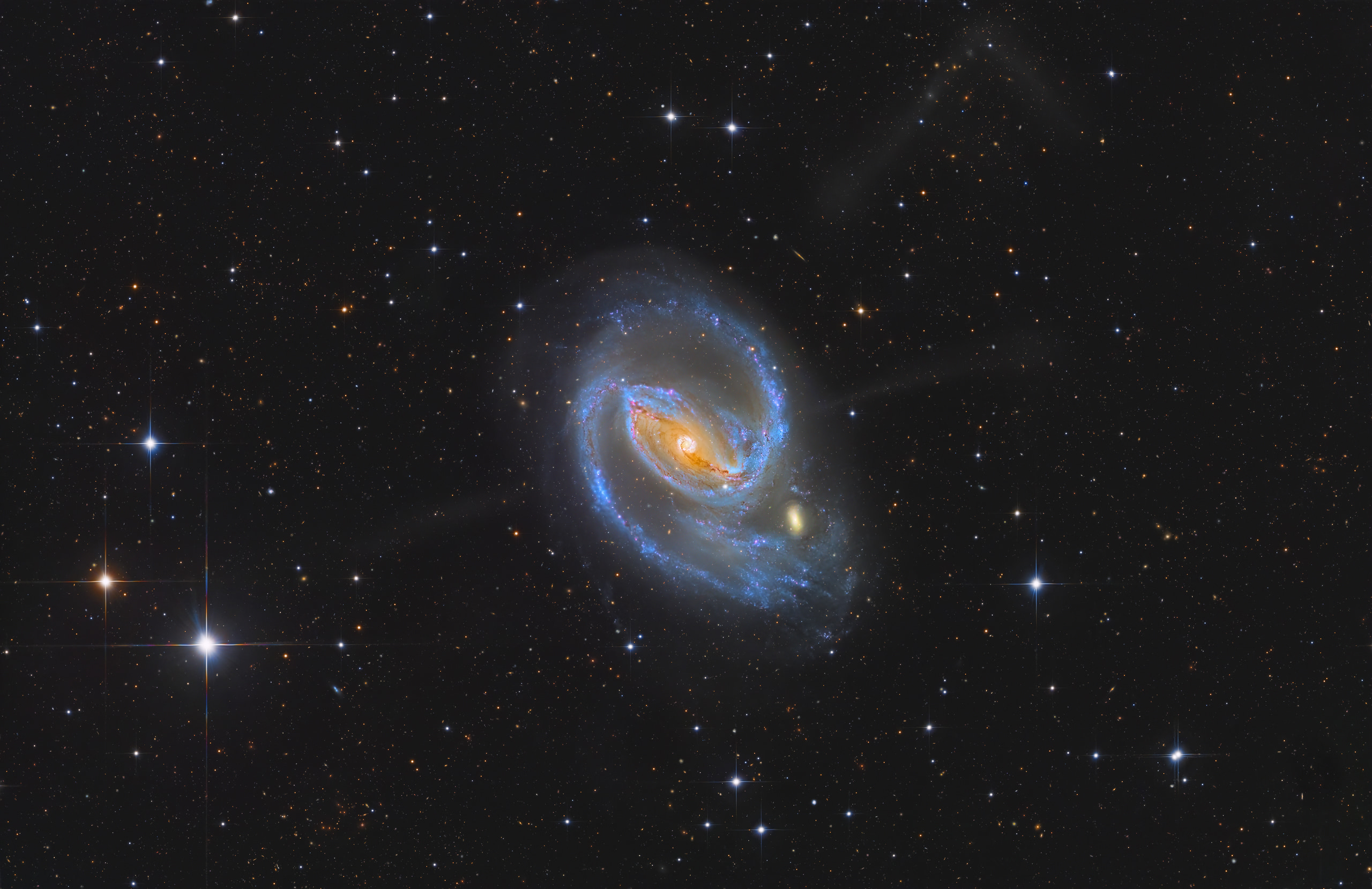
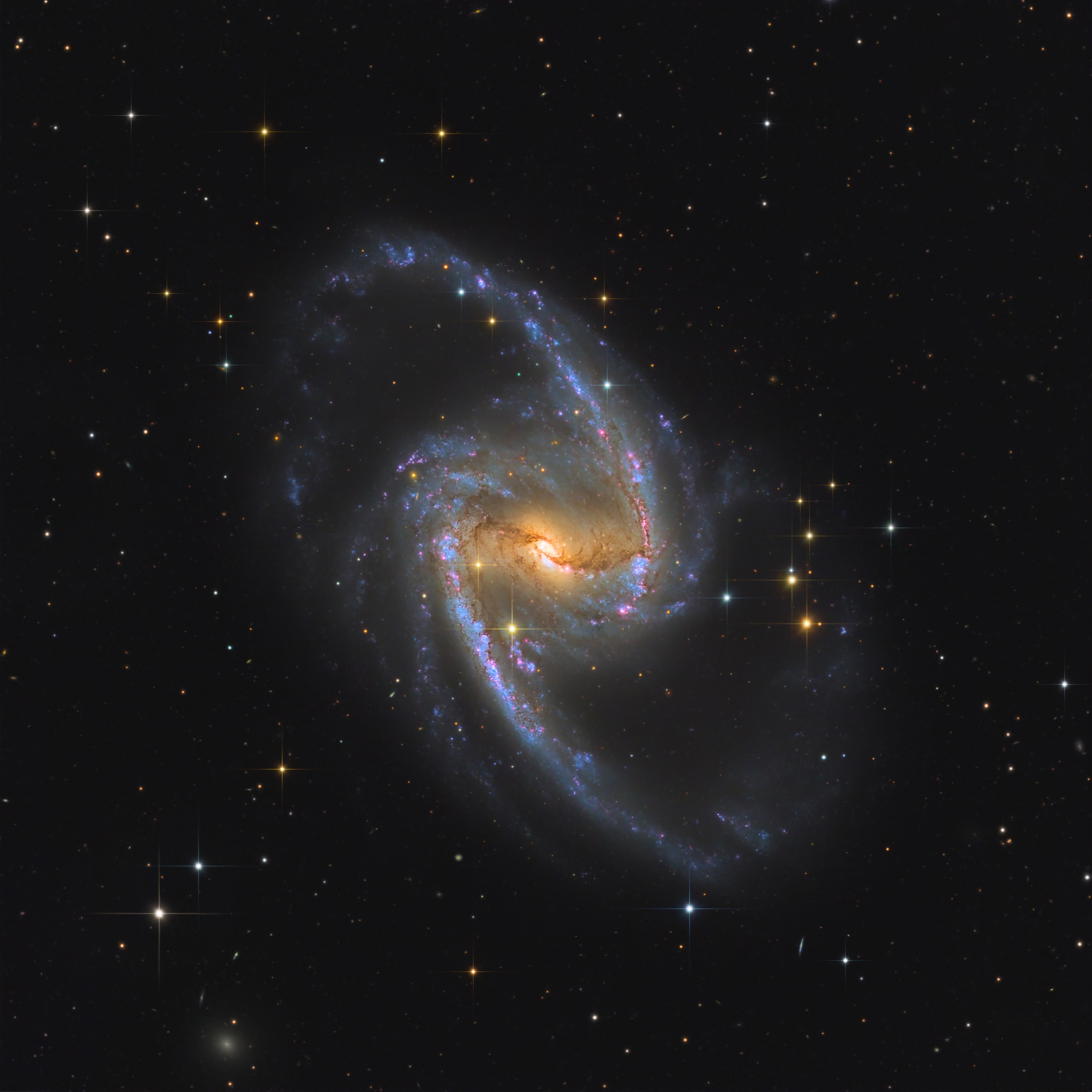
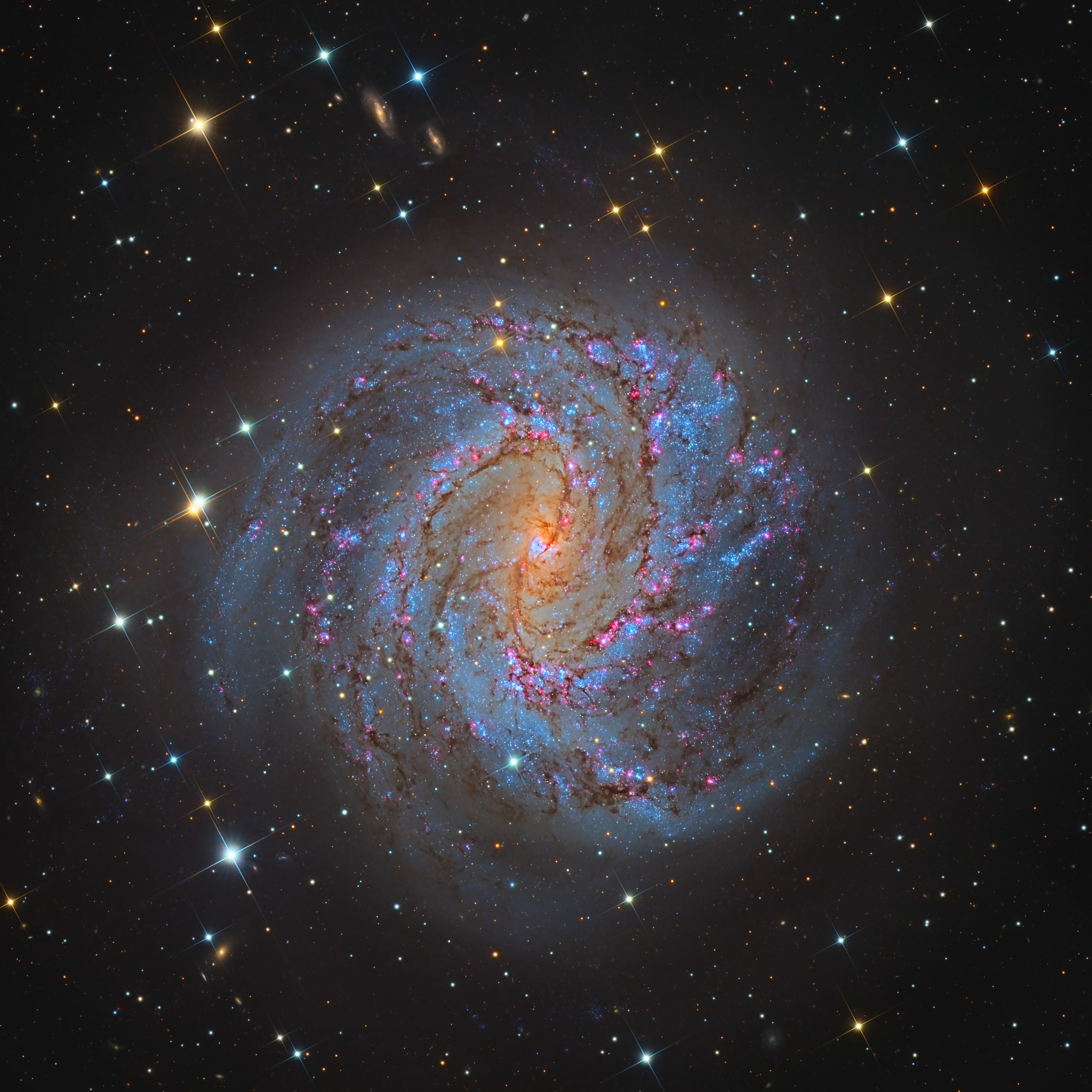
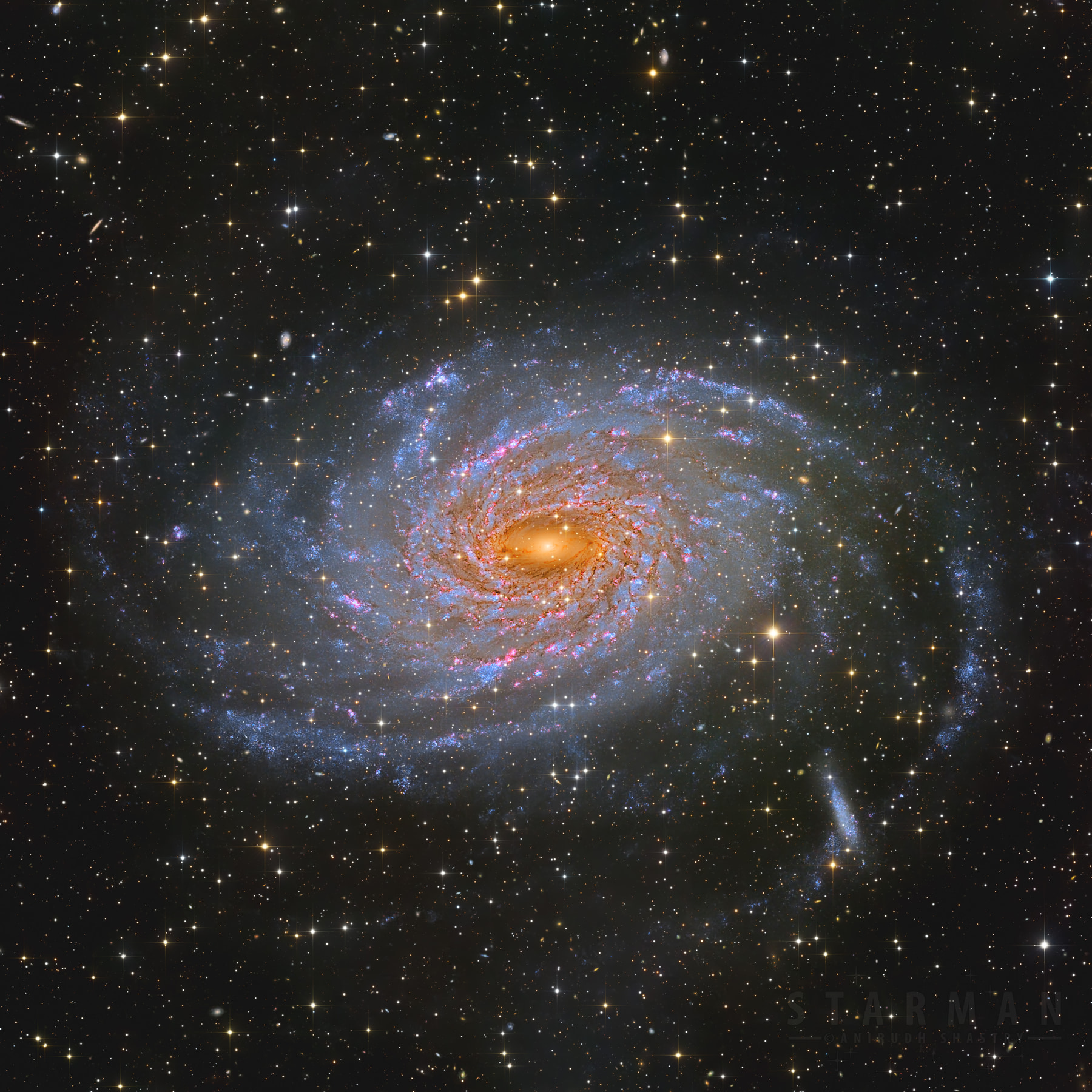
NGC 6744 is often called the Milky Way’s mirror — a grand spiral galaxy some 30 million light-years away in Pavo, the Peacock, and one of the most compelling reasons to point a telescope at the far southern sky. Spanning roughly 175,000 light-years, it is nearly twice the size of our own galaxy, yet built to a strikingly familiar plan: an elongated golden core of ancient stars, a gentle central bar, and loose, feathered spiral arms that unwind into the dark with unhurried grace. If we could somehow step outside the Milky Way and look back, many astronomers believe the view would look very much like this.
The structure of the galaxy reveals itself as color. The core glows warm and amber with the light of older stellar populations, while the arms scatter outward in cooler blues — young clusters strewn like sea spray along the spiral’s edge. Threaded through them, the 5nm hydrogen-alpha data ignites dozens of rose-colored HII regions: individual stellar nurseries, each one a cloud of gas collapsing into new suns, strung along the arms like beacons marking where the galaxy is still actively creating. And at the edge of the frame, the story turns gravitational — the distorted companion NGC 6744A hangs off one outer arm, tugged out of shape by its parent, much as the Magellanic Clouds orbit and interact with our own Milky Way. The resemblance to home runs deeper than appearance.
What draws me to NGC 6744 is precisely that resemblance. We are embedded inside our own galaxy and can never see its face; every map of the Milky Way is an inference, assembled from within the forest. But here, suspended in the still fields of Pavo, is something very close to a self-portrait — a galaxy of the same family, caught mid-rotation, its bar channeling gas inward, its arms quietly manufacturing stars. Looking at it feels less like observing a distant object and more like being handed a mirror across 30 million light-years.
Over 31 hours of integration went into this rendering. The deep luminance carries the fine structure — the dust texture of the core, the faint outer reaches of the arms as they dissolve into the surrounding star field — while the RGB preserves the contrast between the old golden heart and the young blue periphery. The long hydrogen-alpha exposures were the final layer, isolating the star-forming regions so they emerge from the arms not as noise but as signal: small red declarations that this galaxy, like ours, is still being born.
Captured from my remote setup at Obstech in Chile:
🔭 PlaneWave CDK600 Observatory System
📸 Moravian C5A-100M Camera
🎨 Chroma L, R, G, B, and 5nm Ha Filters
📀 L: 58×600s, R: 52×300s, G: 63×300s, B: 54×300s, Ha: 22×1200s (31.08 hours)
🖥️ Processed in PixInsight and Adobe Photoshop